OFW
Global Emergency Services For Compulsory Insurance Coverage For Agency Hired Migrant Workers
Bookmark this page so you can easily return to it from Assist America’s Website.
The Assist America program supports you when you have a medical emergency away from home. Whenever you are in your foreign assignment country, or on business travel originating from the assignment location, you can call upon Assist America’s vast resources to help solve any medical emergency–all it takes is a single phone call. (Travel to or in your home country is excluded.)
Assist America’s Operations Center is staffed 24/7 by medically-certified professionals who can help you quickly and efficiently. The program has no exclusions for pre-existing conditions, geographic risk, adventure sports, alcohol-related incidents or suicide, and employs 100% U.S.-style standards of care. Assist America’s policy is to “solve the problem” with powerful resources when it comes to travel urgencies.
Assist America Service Descriptions
Emergency Medical Evacuation
It is no secret that the quality of healthcare varies widely from location to location. Assist America evens the odds by keeping up to date on medical resources in geographies all over the world. If a member becomes ill or injured in an area of the globe where appropriate care is not available, we will intervene and use whatever transportation, equipment and personnel are necessary to evacuate that individual safely to the nearest facility that meets our rigorous standards. And the full cost of any evacuation, including medical treatment while in transport, is paid by Assist America.
Repatriation
There is no sweeter music to the ears of a patient than news from the doctor of being released to go home. Unfortunately, sometimes the mind’s enthusiasm is ahead of the body’s capabilities, especially for the physical challenges of a long journey after being debilitated. Assist America, when deemed medically necessary, will provide transportation home or to a specified health facility with a medical or non-medical escort as required.
Compassionate Transport
Being compromised away from home is a stressful, intimidating experience for a patient, and being away from familiar faces and surroundings only makes it worse. At the same time, loved ones back home are often frantically worried. Assist America realizes that having a family member or friend present during a health crisis makes everyone feel more at ease and can even hasten the recuperation process. That is why we will arrange and pay the transportation costs for a loved one to join any member who is expected to be hospitalized for more than seven days.
Return of Mortal Remains
In the unfortunate event that a covered individual passes away while traveling, Assist America will arrange and pay for the necessary paperwork, body preparations and transport to bring the mortal remains home. Families who have experienced loss of a loved one have consistently thanked us for offering this service, saying it is a source of true comfort both emotionally and financially in times of great sadness.
21 Personal Security Precautions for OFWs Working in the Middle East
There are some basic precautions you can take to increase your level of personal security while living and working in the Middle East. Most of the principles below are general in nature and applicable in most regions of the world. Most importantly, use common sense and always maintain awareness of your environment.
1. Adhere to the local customs around you whenever possible.
2. Try to blend in with those around you, especially in your dress; avoid a tourist appearance.
3. Do not discuss your itinerary, place of lodging, or any other personal matters with strangers.
4. Ignore attempts by locals to engage in potentially controversial topics, including, religion, politics, and war.
5. Avoid all demonstrations and civil disturbances; leave the area immediately if caught in an impromptu assembly.
6. Do not photograph police stations, military installations, government buildings, airports, ports or train stations without first determining whether photography is permitted. If in doubt, ask permission from someone in authority before taking any photographs.
7. Be knowledgeable of any restricted areas requiring entry permits, and attain these documents before traveling to such locations.
8. Avoid viewing maps in plain view; keep cameras and video equipment in a bag when possible; avoid walking around with such items hanging from your neck.
9. Avoid carrying a purse or wallet. You will often be in crowded areas that are prime hunting grounds for pickpockets and purse-snatchers. If you must carry a wallet, wrap it in a rubber band – this creates friction, making it harder to pickpocket – or use a chain to attach your wallet to a belt loop. Do not use fanny packs or tummy packs – these advertise where your valuables are.
10. Do not flash large amounts of money when paying a bill. If paying in cash, give the vendor an amount close to the purchase price.
11. Leave spare cash, jewelry, passports, tickets, and personal papers in a secure place.
12. Discuss with family and friends what they should do in the event you are involved in a terrorist situation. Do this also with your trip companions.
13. Inform trusted people of your travel plans and keep them informed of changes.
14. Ask your employment staff where foreigners usually congregate and avoid those places, especially if there is known animosity in a country against your nationality or ethnicity.
15. Keep a mental note of safe havens, such as police stations, hotels and hospitals. Mark these on a local map.
16. Refuse unexpected packages from unknown persons, businesses or organizations.
17. When driving, avoid predictable times and routes of travel. Vary modes and times.
18. In crowded streets, always drive with windows up and doors locked. Bombs and other objects can be thrown through open windows. Unlocked doors and be easily opened from the outside during stops or in traffic jams.
19. If you hear an explosion, stay away from windows. A second, and usually more violent, explosion follows many explosions. Seek shelter in your bathroom or, if possible, an interior stairwell.
20. If shooting starts, drop to the floor or get down as low as possible and try to shield yourself behind or under a solid object.
21. Avoid all suspicious objects. Never touch or pick up a suspicious object, and leave the area if you see any. Terrorists, organized crime figures and others are skilled in hiding explosives in a variety of objects. Any item that cannot be identified as belonging to a specific person or in a particular place should be treated as suspicious.
Click here for an OFW Survival Guide
Other Helpful Links for OFW’s
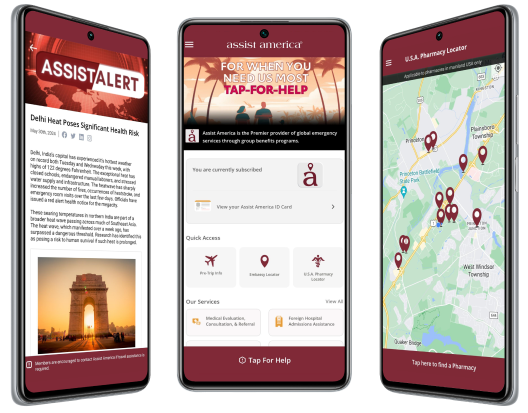
Download The Assist America Travel App Today!
Available now on Apple App Store & Google Play